![[our] fragrances](http://www.kerzon.paris/modules/pm_advancedtopmenu/menu_icons/10-en.jpg "[our] fragrances") [our] fragrances
[our] fragrances
![[For] the home](http://www.kerzon.paris/modules/pm_advancedtopmenu/menu_icons/2-en.jpg "[For] the home") [For] the home
[For] the home
![[for] the linens](http://www.kerzon.paris/modules/pm_advancedtopmenu/menu_icons/21-en.jpg "[for] the linens") [for] the linens
[for] the linens
![[for] the body](http://www.kerzon.paris/modules/pm_advancedtopmenu/menu_icons/5-en.jpg "[for] the body") [for] the body
[for] the body
 Kerzon's House
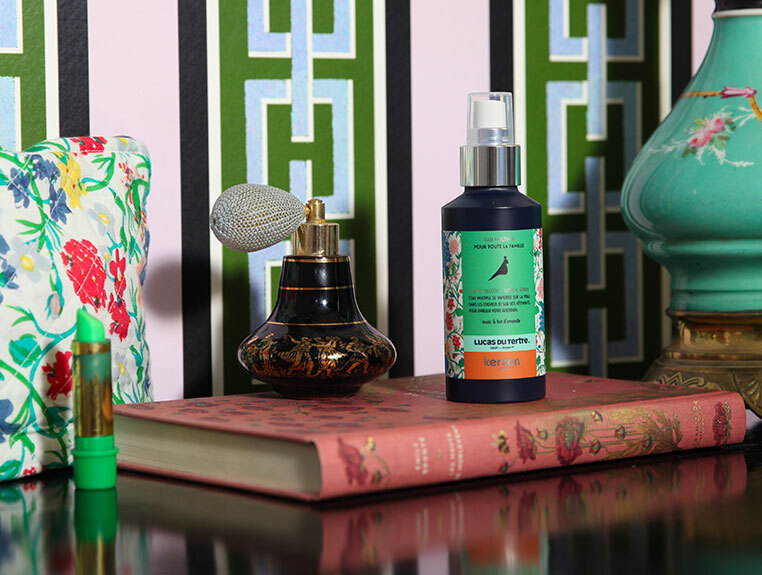 x Lucas du Tertre
The What’s-It-All-About of Perfume
Top notes, trail, concentration… The vocabulary of perfumery can be complex to decipher. Because a fragrance is a living material that must be tamed, we’ve decoded for you the behind-the-scenes of its creation. A little refresher course to become an expert in sillage.
.jpg)
To create your fragrance, the "pure concentrate"—the juice crafted by the perfumer—is infused into a hydro-alcoholic complex: it is this dosage that determines the intensity and longevity of your scent.
- Parfum (or Extrait): The richest formula. With a concentration between 20 and 30%, it offers long-lasting wear and a deeply enveloping presence with just a few drops.
- Eau de Parfum: The embodiment of elegance, concentrated at 15–20%, it is highly intense and lasts on the skin throughout the day.
- Eau de Toilette: With a concentration between 5 and 15%, it stands out for its balance. Ideal for those who appreciate freshness and subtlety, it leaves an elegant trail without ever being overpowering and can be reapplied throughout the day, or layered to create your own personalized signature scent.
- Eau de Cologne & Eau Fraîche: For an instant burst of freshness. With a concentration between 1 and 4%, they are invigorating and more fleeting—perfect for scenting yourself on summer evenings.
.jpg)
They are often confused, but these are the two pillars of your fragrance’s "life."
- Sillage = the trail: This is your perfume’s ability to travel through the air. It’s the invisible trace you leave behind after crossing a room. A sillage can be subtle or generous, depending on the volatility of the notes.
- Longevity = the wear: This is the lifespan of the fragrance on your skin. It’s what ensures that an eau de toilette remains present in the background throughout the day.
Did you know? A perfume can have excellent longevity (lasting a long time on you) without necessarily having a strong sillage (not being detected by others 10 meters away). This is the subtlety of Kerzon’s dosing: prioritizing faithful wear rather than an overwhelming presence.
.jpg)
A perfume never reveals itself all at once: it evolves on the skin over time. That’s why we talk about the olfactory pyramid—to understand how the notes unfold on the skin.
1. Top Notes (The First Impression): These are the most volatile. Fresh and sparkling (citrus, aromatic notes), they are perceived immediately upon first application. They give the first impression and subtly make way for the other notes.
2. Heart Notes (The Identity): These form the heart of the perfume, rounder and more balanced (often floral or fruity). They develop after a few minutes and last several hours. They represent the personality of your fragrance trail.
3. Base Notes (The Memory): These are the most lasting notes (woods, vanilla, musks). They provide depth and ensure longevity. They fully emerge after a few hours and can linger on clothing for several days.
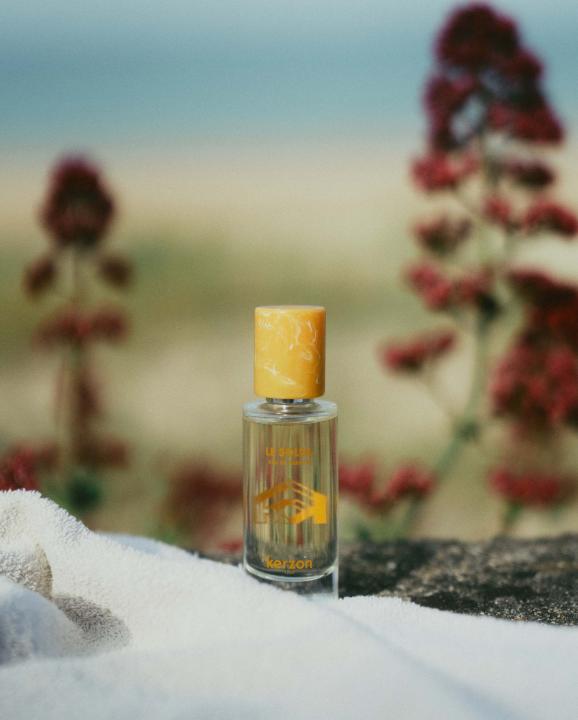
Contrary to popular belief, perfumery is not a battle between "good" natural and "bad" chemistry. At Kerzon, we believe the secret to a beautiful fragrance lies in the balance between these two worlds.
- Natural: Derived from flowers or woods, natural extracts or essences bring unique richness and complexity. They give the perfume its "soul" and a touch of mystery.
- Synthetic: Essential for recreating the scent of "silent" notes that cannot be extracted (like fig or lilac). It also helps protect nature by replacing materials from animals or protected plants. Synthetics are the tool that allows perfumers to be both more creative and more responsible.
Read our dedicated article on natural and synthetic ingredients
.jpg)
Perfume allergens are molecules naturally present in essential oils and other ingredients that make up a fragrance. Here’s the little paradox: natural does not mean allergen-free. A rose or lemon essential oil naturally contains molecules that can be sensitizing.
For your safety, these components are listed at the end of our ingredient lists. They are strictly regulated so that your perfume remains a worry-free experience, even for sensitive skin.
So you don’t need to worry about them if you’re not allergic.
Read our full article dedicated to allergens.